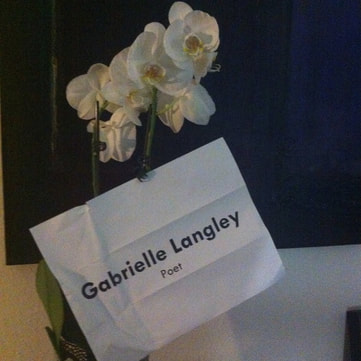
Gabrielle Langley is a poet and author of Fairy Tale (Sable Books, 2022) and Azaleas on Fire (Sable Books, 2019). She has been featured in the Houston Chronicle and the Huffington Post as one of Houston's important emerging poets. She has won the Lorene Pouncey Award, the Vivian Nellis Memorial Award for Creative Writing, and has appeared as Featured Poet for Houston Poetry Fest. With poetry appearing in literary journals in the United States and Europe, she was selected by Italian design house, Max Mara, to be the Featured Poet for their first-time U.S. poetry event, and she collaborated with Max Mara to ensure that proceeds from the event were donated to the Barbara Bush Literacy Foundation. (Ms. Langley also donates one-hundred percent of the profits from Azaleas on Fire to this same foundation). With her strong belief that poetry needs to be accessible to all people, she was chosen to work on the 2017 selection committee for Public Poetry’s Library Reading Series. She was also a spearhead and co-editor for Red Sky: Poetry on the global epidemic of violence against women (Sable Books – 2016). Ms. Langley works during the day as a licensed mental health professional who served as front-line “essential staff” throughout the COVID pandemic. To safeguard her own mental health, she writes poetry and dances Argentine tango at night.
_______________________________________________________________________________________________
Poet's Statement: I am especially interested in exploring romantic themes within a very disciplined and restrained style. I am also fascinated by the art of compressing vast stories into small spaces. I have been described as a "Neo-Romantic." Paradoxically, I am also devout minimalist in my aesthetics. I am often told by other poets – and I consider this a true compliment – that my style shows a romantic's sensibility captured within a minimalist framework. I love this idea; I like to call it Romantic Minimalism. I love blending these two seemingly disparate styles.
My work has also been described as European. It is strongly influenced by European fairy tales, legends, ghost stories, ballets, and operas. My first father, born and raised in Berlin, had an enormous impact on how I perceive the world. He told me stories of living through countless bombings when he was a small boy during WWII. His neighborhood transformed into rubble, he survived starvation, the Russian invasion, escape from a Russian concentration camp, and by a series of small miracles, went on to graduate from the Academy of Fine Arts in Vienna as a young man. My father was very Old World. He raised me on fairy tales and real life stories of terrible danger. He taught me the importance of escape, meticulous attention to detail, and outfoxing one's enemies. He also taught me that fear and danger could be interlaced with absolute magic and profound beauty.
At the same time, I was raised in the South of the United States where my mother was an intrepid gardener. I grew up in a world filled with flowers, humidity, frequent rain and the rich black gumbo soil that we have here in the southeast. Anyone who knows me well knows that I am obsessed with white flowers— white lilies, Phalaenopsis orchids, gardenias, magnolias, climbing jasmine, etc. These flowers make frequent appearances in my work. My poem "Narcissus,” for example, draws heavily on the intoxicating magic of these tiny flowers. Flowers of all colors seem to spring up without invitation when I am writing. They weave themselves into the lines of my poetry, even when I am trying to keep the piece sleek and contemporary. No doubt, this is the influence of my mother's gardening.
My parents and grandparents have passed away now. These days, I feel like something of an orphan. Moreover, I am not a religious person. I have never been convinced, one way or the other, that there is, or is not, an after-life. Quantum physics has always made far more sense—and brings far more comfort to me—than any religious doctrine. I do love science and inquiry, the willingness to investigate a hypothesis. In the face of the cosmos, I am humbled.
I cannot pretend to know the cosmic order of things. Even so, it often feels like the ghosts of my parents return to visit me while I am writing. At these times, I sense them sitting here in the same room with me, and I feel truly grateful for this. My poems are given back to them in thanks. —--GL
Poet's Statement: I am especially interested in exploring romantic themes within a very disciplined and restrained style. I am also fascinated by the art of compressing vast stories into small spaces. I have been described as a "Neo-Romantic." Paradoxically, I am also devout minimalist in my aesthetics. I am often told by other poets – and I consider this a true compliment – that my style shows a romantic's sensibility captured within a minimalist framework. I love this idea; I like to call it Romantic Minimalism. I love blending these two seemingly disparate styles.
My work has also been described as European. It is strongly influenced by European fairy tales, legends, ghost stories, ballets, and operas. My first father, born and raised in Berlin, had an enormous impact on how I perceive the world. He told me stories of living through countless bombings when he was a small boy during WWII. His neighborhood transformed into rubble, he survived starvation, the Russian invasion, escape from a Russian concentration camp, and by a series of small miracles, went on to graduate from the Academy of Fine Arts in Vienna as a young man. My father was very Old World. He raised me on fairy tales and real life stories of terrible danger. He taught me the importance of escape, meticulous attention to detail, and outfoxing one's enemies. He also taught me that fear and danger could be interlaced with absolute magic and profound beauty.
At the same time, I was raised in the South of the United States where my mother was an intrepid gardener. I grew up in a world filled with flowers, humidity, frequent rain and the rich black gumbo soil that we have here in the southeast. Anyone who knows me well knows that I am obsessed with white flowers— white lilies, Phalaenopsis orchids, gardenias, magnolias, climbing jasmine, etc. These flowers make frequent appearances in my work. My poem "Narcissus,” for example, draws heavily on the intoxicating magic of these tiny flowers. Flowers of all colors seem to spring up without invitation when I am writing. They weave themselves into the lines of my poetry, even when I am trying to keep the piece sleek and contemporary. No doubt, this is the influence of my mother's gardening.
My parents and grandparents have passed away now. These days, I feel like something of an orphan. Moreover, I am not a religious person. I have never been convinced, one way or the other, that there is, or is not, an after-life. Quantum physics has always made far more sense—and brings far more comfort to me—than any religious doctrine. I do love science and inquiry, the willingness to investigate a hypothesis. In the face of the cosmos, I am humbled.
I cannot pretend to know the cosmic order of things. Even so, it often feels like the ghosts of my parents return to visit me while I am writing. At these times, I sense them sitting here in the same room with me, and I feel truly grateful for this. My poems are given back to them in thanks. —--GL